
Travel Information & Tips
General Travel Information: CAPE VERDE
Below you will find some useful tips and information for your trip to the Cape Verde Islands. All information is provided without guarantee and is not intended to be exhaustive.
Entry
To enter the country, you need a passport valid for 6 months beyond your return date, as well as a visa for non-European citizens.
As of January 1, 2019, European citizens are no longer required to obtain a visa. The visa requirement has been replaced by a registration requirement for entry and payment of an airport security fee of €31. You can pré-register online 5-7 days before your arrival at https://www.ease.gov.cv/. During the registration process, you will be asked to pay the security fee by Visa card. Alternatively, you can register and pay the security fee directly upon arrival – in cash or by Visa card. However, it is more convenient to have the registration completed in advance.
If you are a non-EU citizen or have further questions, for example, regarding long-term stays, please contact the Cape Verde Consulate or Embassy responsible for your region.
You can also obtain current travel information at:
https://www.auswaertiges-amt.de/de/ReiseUndSicherheit/caboverdesicherheit/208824


Vaccination Requirements and Health
If you are traveling from a European country, vaccinations are generally not required. However, as with any trip, we recommend getting a tetanus shot.
Vaccinations against hepatitis A and polio are also recommended. A valid yellow fever vaccination is required for all travelers arriving from a yellow fever-endemic area.
Malaria:
On the island of Santiago, there is a very low risk of malaria during the hot and humid months (July through October). Medicinal malaria prophylaxis is not recommended, but you should use mosquito repellent in this case.
Dengue fever, transmitted by the diurnal tiger mosquito, caused an epidemic on the southern islands in 2010, which was combated in an exemplary manner. Since then, no new cases of dengue have been reported to us.
Medical Care
There are health clinics and hospitals on the inhabited islands, but diagnostic and treatment options are often limited compared to Europe. As a tourist, you must also cover the costs of doctors, hospitals, treatment, and medication yourself. In the event of serious illness or accidents, evacuation abroad may be necessary.
We therefore recommend travel insurance that includes repatriation coverage.
Many medications are not available in Cape Verde. Therefore, it is best to pack any medications you may need in your checked luggage. Important medications are generally safer when kept in your carry-on luggage.
Hygiene
In the relatively warm climate of Cape Verde, bacteria multiply faster than in Central Europe. Since the European digestive system is not accustomed to Cape Verdean bacteria, there is an increased risk of diarrhea, especially during the hot and humid season around August–September.
In addition, a large portion of the population—especially those living in rural areas—has no access to sanitary facilities or only limited access to them. The majority of cases of diarrhea are not transmitted through contaminated food but through hand contact. Washing your hands, especially before eating, is essential!
We recommend bringing disinfectant wipes to sanitize your hands throughout the day.
If you are particularly sensitive, taking a preventive medication to strengthen your gut flora might also be advisable—please consult your doctor or pharmacist.
Always cover small open wounds to prevent infections from flies.
Be cautious with Cape Verdean goat cheese, which is often made from raw milk without regard for any hygiene regulations.
Drinking Water
Do not drink tap water. Drinking water in 1.5-liter plastic bottles is widely available in stores. By the way, the rural population is happy to receive empty bottles for reuse.
Poisonous animals
The only poisonous animal found in Cape Verde is the scorpion-like and rather shy centipede, which likes to hide in dark crevices. Its bite is comparable to a bee sting and causes an unpleasant burning sensation and slight swelling at the bite site, but like a bee sting, it can also trigger allergies.
If you are prone to allergies, we recommend bringing appropriate medication.
Note: We cannot guarantee the accuracy or completeness of the medical information provided, nor can we accept liability for any resulting damages. You remain responsible for your own health.
Luggage
Important information regarding checked baggage:
Please note that on domestic flights within Cape Verde, the baggage allowance per person is a maximum of 20 kilograms of checked baggage plus 6 kilograms of carry-on baggage, provided you have booked a fare that includes checked baggage. An additional fee must be paid for each additional kilogram of checked baggage prior to departure.
Hiking poles are considered potential weapons and may therefore only be transported in checked baggage on flights, not in carry-on baggage
Our recommendations for luggage: And of course, remember your passport, flight tickets, and Visa card (PIN code!).
- Comfortable, lightweight clothing in layers
- Lightweight fleece to wear over your clothes in the mountains or in the evening
- Sun hat
- Sunscreen with at least SPF 30; higher SPF for the face and at the beach
- Medications, first-aid kit, bandages, possibly an elastic bandage
- Hiking boots with good tread and ankle-high
- Trekking sandals
- Flip-flops for the beach
- Insect repellent
- Possibly hiking poles
- Lightweight rain jacket
- Flashlight or headlamp (power outages)
- Power bank
- Possibly a spare battery for the camera (power outages)
We recommend that you always wear your hiking boots on flights or carry them in your carry-on luggage, as checked luggage may occasionally arrive later. Also, charging cables and important medications should always be in your carry-on luggage.

Climate of Cape Verde
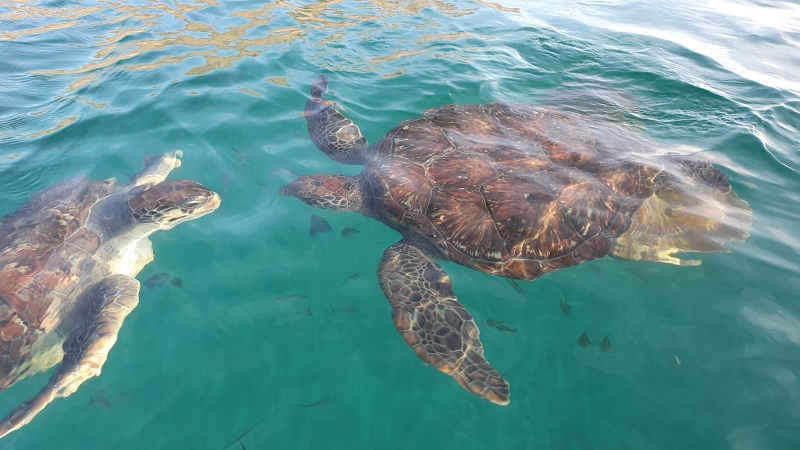
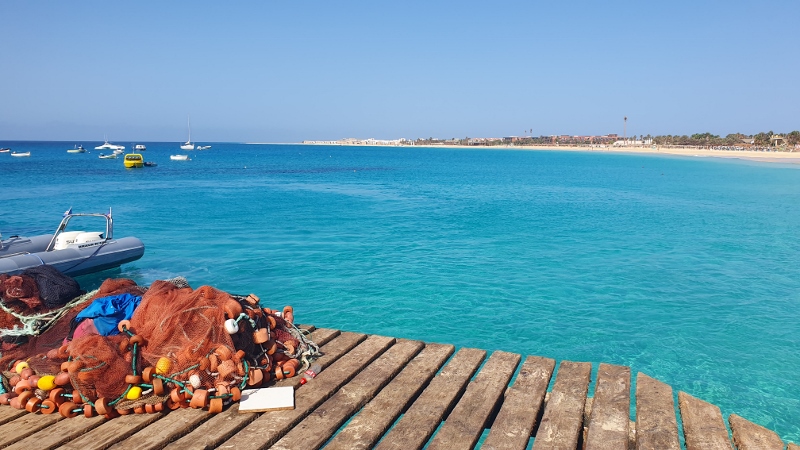
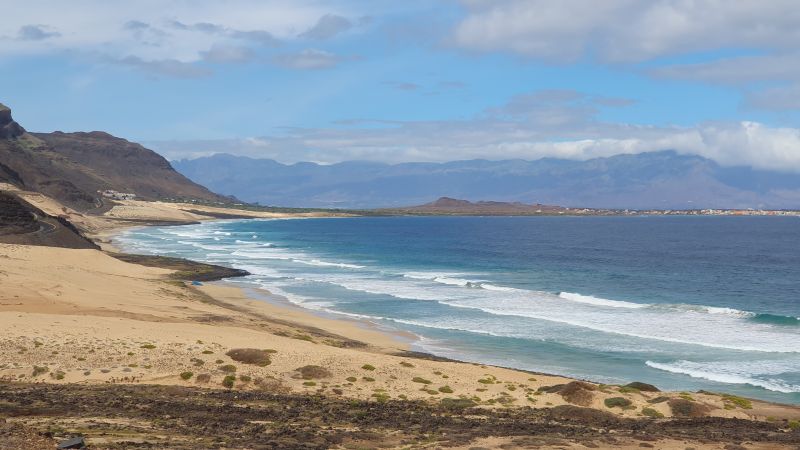
The climate on the Cape Verde Islands is pleasantly warm, with temperatures generally ranging between 20 and 30 degrees Celsius. Almost all year round, the northeast trade winds bring a pleasant, light breeze. In late summer and early fall, tropical air masses from the south reach the islands, which can lead to short, heavy rain showers.
Time Difference
The time difference from Central European Time (CET) is minus 2 hours during standard time and minus 3 hours during daylight saving time in Cape Verde.
Safety
Cape Verde is considered a safe and peaceful travel destination. This democratic country is politically stable and free of religious conflicts. However, as is the case anywhere in the world, you should be on guard against theft and drug-related crime, especially in larger cities.
To avoid any inconvenience, we recommend the following precautions: When going on excursions or to the beach, take only the amount of cash you expect to need. It is best to leave larger sums of money, valuables, passports, and airline tickets in the hotel safe.
If you are out and about in larger cities at night, please note the following: – Always take a taxi at night in cities—even for short distances. – It is best to carry your money on your person. If you avoid carrying handbags and wearing conspicuous jewelry, you can travel with greater peace of mind. – Do not walk through deserted streets at night. Report any theft to the police.
Electricity
On the Cape Verde Islands, even prolonged power outages are not uncommon. Therefore, bring a handy flashlight with you on your trip. The voltage is 220 volts, as in Europe; adapters are not necessary.
Currency
The local currency is the Cape Verdean escudo (CVE), which is pegged to the euro. For one euro, you get 110.265 CVE (escudos), minus exchange fees.
On the islands of Sal and Boa Vista, you can also pay with euros, though usually at a less favorable exchange rate.
Exchanging Money
There are currency exchange offices at the airports in Sal and Praia that are open late in the evening and on weekends following the arrival of international flights. There, you’ll pay only slightly higher exchange fees than at banks, where long lines are often to be expected.
If you’re flying with TAP via Lisbon, you can exchange euros there at the airport for up to 20,000 Cape Verdean escudos per person (about 181 euros).
In other European countries, it’s not possible to buy or exchange Cape Verdean escudos.
You must present your passport to exchange money. Exchange only as much as you are certain you will need and keep the receipt. You will need to present this if you wish to exchange the money back at the end of your trip. Relatively high fees are charged for the reverse exchange.
Bank hours:
Mon–Fri 8 a.m.–3 p.m., except on holidays. Remember that you need your passport to exchange money. Money exchange is also possible to a limited extent at larger hotels.
Withdrawing cash and card payments:
There are now ATMs in many places, but they are often out of order or empty, especially on holidays and weekends.
Card payments are not very common in Cape Verde and are only accepted in larger hotels and a few shops. The only credit card that works reliably is the VISA card. The Maestro card works only sporadically.
With the VISA card, you can withdraw a maximum of 2x 20,000 CVE (2x 181 euros) per day from ATMs. You will need your credit card PIN code! Traveler’s checks can be cashed at banks, but are subject to a very high fee.
Our recommendation: for our two-week tours, bring 300 euros in cash per person and use your Visa card as a backup.
Tipping
A tip of 10% is appropriate for good service. First, have the change given to you, and then give the tip. If you pay by card, give the tip separately.
Begging
Begging children and teenagers, and sometimes adults, are found in Cape Verde, especially in the cities and also on the standard hiking trails. Please do not give money; you are not doing any good by doing so. If you wish, share your provisions or buy something to eat, for example.
Sustainable aid
Eyeglasses—especially reading glasses for children—as well as bandages are always in short supply in Cape Verde and are very welcome. Both are gladly accepted at the medical clinics.
Photography
Generally, people in Cape Verde are happy to be photographed—exceptions prove the rule. For close-up shots of people, please ask first and respect a “no” if given. Never give money for photos! If you’ve taken beautiful photos of people, feel free to send them to us. We’ll bring them to the “subjects” on our next tour, and you can be sure you’ll bring great joy to the locals.
VIP Tours Cabo Verde, 01210 Paul, Santo Antão, Cabo Verde Tel. 00238 – 9974590/9740031